
A website redesign is often treated as a visual project: update the layout, modernize the colors, improve the mobile experience, and launch a cleaner version of the same website.
For an established service business, it can be much more complicated.
When a website has been online for years, it accumulates history. Pages are created, SEO strategies change, advertising campaigns come and go, tracking systems are modified, and content that once served a purpose may no longer fit the way the business operates today.
That was the situation we encountered while rebuilding the website for STI Garage Door, a Maryland garage door service company we have worked with since 2017.
The project became more than a visual redesign. It required reconsidering how the website was structured, what content deserved to remain, how services and locations should connect, and how the site could provide a stronger foundation for SEO and paid advertising going forward.
From Website Development to a Broader Digital Strategy
Our relationship with STI Garage Door began in 2017.
For many years, our responsibility was primarily website design and development. SEO strategy was handled by a third-party agency, while we implemented the technical changes and recommendations they provided.
Over time, however, the website became increasingly complex.
New pages had been added for different keywords and search intents. Content accumulated across services, locations, blog posts, and other sections. Some pages remained useful, while others had become thin, repetitive, or disconnected from the site’s broader structure.
At the same time, the website was no longer generating the volume of inquiries the business expected.
In 2026, our role expanded. Instead of simply implementing changes requested by another agency, we became responsible for the website structure, design, technical foundation, on-page improvements, and eventually Google Ads management as well.
That changed the way we approached the project.
The objective was no longer simply to build a better-looking website.
It was to build a better system.
Why an Established Website Requires a Different Kind of Redesign
Redesigning a new website and rebuilding an established website are two very different projects.
An existing site may already have:
- pages indexed by Google for years;
- backlinks pointing to specific URLs;
- service pages receiving organic traffic;
- location pages associated with local searches;
- blog articles ranking for unexpected queries;
- old redirects;
- historical analytics and conversion tracking;
- advertising campaigns connected to existing landing pages.
Removing or restructuring something simply because it looks outdated can therefore create new problems.
Before making major changes, we had to understand which parts of the existing website were still valuable and which parts were creating unnecessary complexity.
This is one of the principles behind our approach to Website Redesign Services:
A redesign should not begin with the question, “How should the new website look?”
It should begin with:
“What should the new website accomplish, and what from the existing site needs to be preserved, improved, consolidated, or removed to get there?”
Rebuilding the Website Architecture
One of the largest parts of the STI Garage Door project involved restructuring the website itself.
Garage door companies often provide a surprisingly broad range of services. Residential and commercial work can involve installation, repair, maintenance, openers, gates, individual components, brands, and different service areas.
Without a clear hierarchy, years of adding pages can gradually turn a website into a collection of loosely connected URLs.
We reorganized the site around clearer relationships between the major sections of the business.
Services were reconsidered based on what the company actually provides and how customers search for those services. Residential and commercial offerings received clearer separation. Location content was reorganized. Brand and gate-related content became part of a more intentional structure.
This was particularly important because STI operates as a local service business in Maryland.
For businesses like this, service and geographic relevance often overlap. A strong garage door service website needs to communicate not only what the company does, but also where those services are available, without creating hundreds of repetitive pages simply to target keyword combinations.
Removing Thin and Overlapping Content
More pages do not automatically create a stronger website.
Over the years, pages can be created around individual keywords, questions, or slight variations of the same topic. At some point, several URLs may effectively compete to explain the same thing.
During the redesign, we reviewed this accumulated content and removed or consolidated pages that no longer justified existing independently.
The goal was not to make the website smaller simply for the sake of having fewer pages.
The goal was to make every important page have a clearer purpose.
That distinction matters.
A useful service page, location page, case study, or detailed article can strengthen a website. A collection of near-duplicate pages created primarily because different keyword variations exist can make the overall structure harder for visitors and search engines to understand.
A Redesign Can Expose Existing SEO Problems
One of the more interesting issues became visible when reviewing how Google interpreted different parts of the site.
In some cases, an informational article could appear for a commercially oriented search where we would prefer Google to show the corresponding service page.
That does not necessarily mean the article is bad.
It can indicate that Google sees stronger relevance, internal signals, content, or historical authority on the informational URL than on the commercial page.
Simply deleting the article would not address the underlying issue.
Instead, situations like this require looking at the relationship between pages:
- Does the service page fully satisfy the commercial intent?
- Are internal links reinforcing the correct page?
- Is anchor text helping establish the relationship between topics?
- Is informational content properly connected to the relevant service?
- Are multiple pages competing for essentially the same search intent?
These are the kinds of issues that become difficult to solve when design, development, content, SEO, and advertising are treated as completely separate systems.
Performance Matters, but PageSpeed Is Not the Strategy
The redesigned website launched in July 2026.
At delivery, Google PageSpeed Insights reported scores of 92 on mobile and 100 on desktop. Performance scores naturally fluctuate as tests, content, scripts, and third-party resources change.
We were happy with the technical result, but PageSpeed was never the primary objective.
A website can load extremely quickly and still perform poorly as a business asset.
It can have a 95+ performance score while having confusing navigation, weak service pages, poor internal linking, unclear calls to action, or a structure that does not reflect how customers actually search.
Performance is one component of a good website.
It is not a substitute for one.
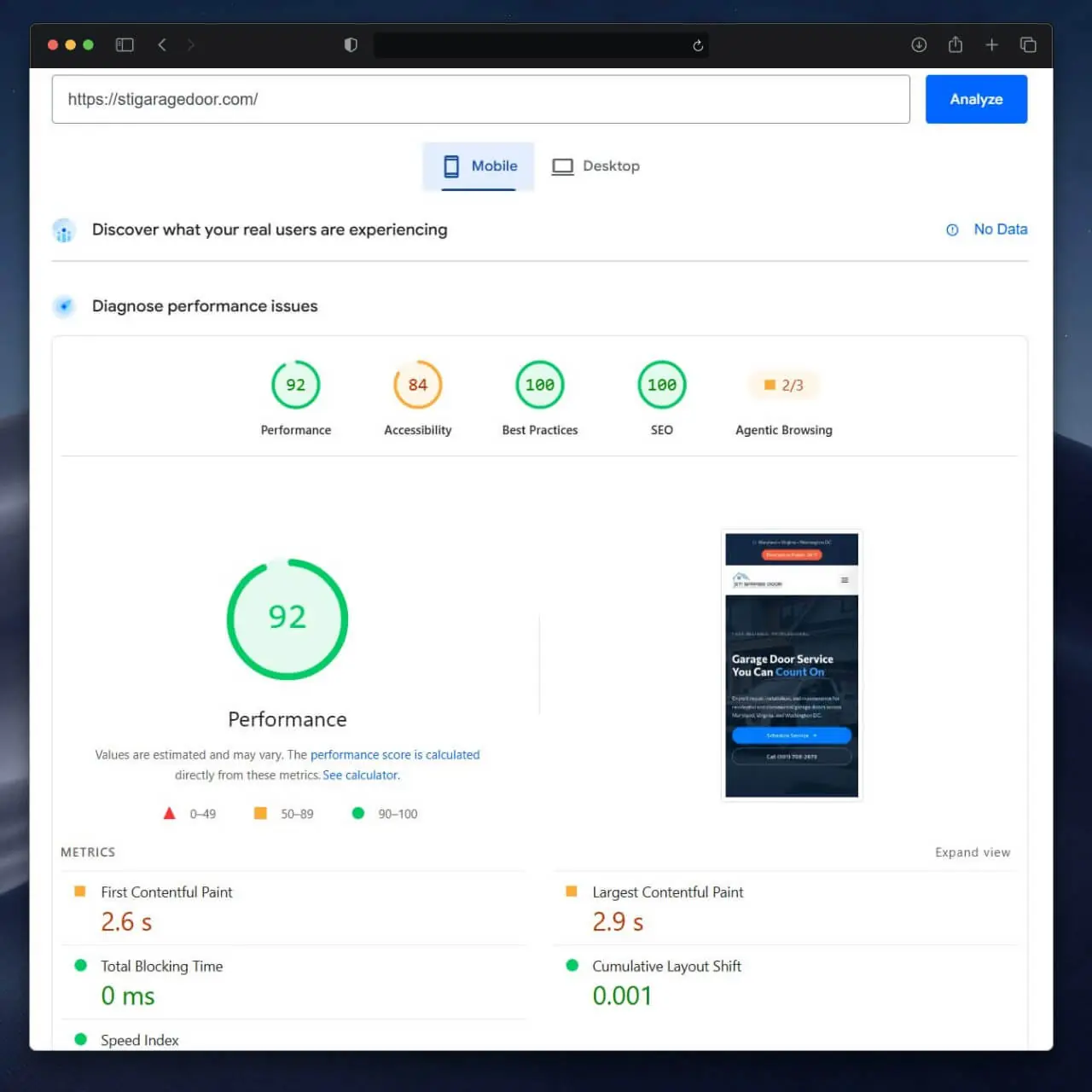
Google PageSpeed Score for Mobile
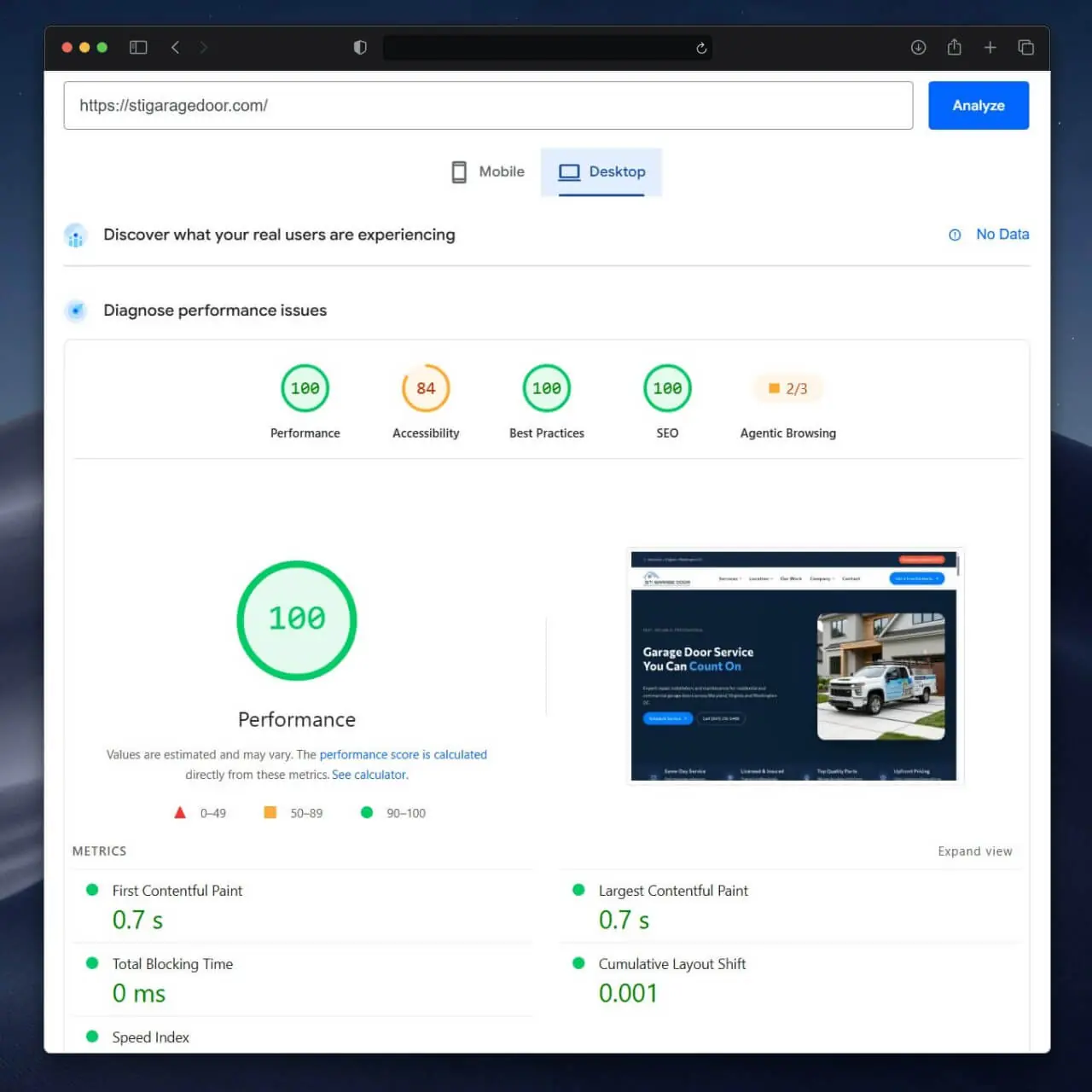
Google PageSpeed Score for Desktop
The Work Does Not End at Launch
One of the biggest misconceptions about website redesign is that launch day represents the end of the project.
For an established website, it is often the beginning of the next phase.
STI Garage Door has years of existing content and search history. After rebuilding the foundation, there is still ongoing work involving:
- reviewing older content;
- improving metadata;
- refining internal linking;
- monitoring indexing and search queries;
- evaluating which URLs Google selects for important searches;
- improving commercial pages where necessary;
- reviewing redirects and legacy URLs;
- monitoring conversions and user behavior.
We are also cleaning up years of accumulated Google Tag Manager implementations.
Tracking systems tend to become surprisingly messy over time. Tags are added for different campaigns, analytics configurations change, conversion actions are replaced, and old implementations sometimes remain long after they are needed.
Cleaning this up is not visually impressive, but reliable data is essential if SEO and advertising decisions are going to be based on actual performance.
Why We Are Not Calling the Project an SEO Success Yet
The website launched in July 2026, so it is still too early to make meaningful claims about the long-term organic impact of the redesign.
And we think that distinction is important.
A redesigned website should not be declared an SEO success because a PageSpeed score improved or because the new version looks better.
Google needs time to crawl changed pages, process redirects, reassess internal relationships, and understand a substantially modified site structure.
We are monitoring the site through Google Search Console and other analytics data as that process continues.
Over the coming months, the more useful questions will be:
- Did important commercial pages gain visibility?
- Did Google begin selecting the intended pages for important searches?
- Did organic traffic become more relevant?
- Did qualified inquiries improve?
Those results will tell us far more than the launch-day performance score.
What This Project Reinforced for Us
The STI Garage Door redesign reinforced something we have seen across many website projects:
Good web design, technical SEO, content structure, and conversion strategy cannot always be separated cleanly from one another.
The CMS itself is rarely the deciding factor.
WordPress or another reasonable platform can provide a strong technical foundation when the people working on the website understand what they are changing, why they are changing it, and what business outcome the site is supposed to support.
For an established local business, the strongest redesign is not necessarily the one that looks most different.
It is the one that leaves the business with a clearer, faster, easier-to-manage website and a stronger foundation for the years ahead.
STI Garage Door is a good example of that process, but the work is not finished.
You can explore the complete STI Garage Door case study to see the project, our role, and the finished website.
For businesses planning a similar project, learn more about our work with Garage Door Service companies, or our website development work for businesses in Maryland.

Professional websites for small businesses and service companies.
Designed to present services clearly and attract new customers.

Other Insights
Smart Ideas for
Growing Online
Growing Online